

Mem0 or Jackdaw: how to choose
Where they are the same, where they differ, what each costs, and which one fits what you are building.
By Jackdaw Team
Mem0 and Jackdaw both give AI a long-term memory. Both pull what matters out of conversations, keep it, and hand the right part back when a model needs it. Both have a hosted MCP server and a plugin for Claude Code.
They differ in what they are. Mem0 is memory infrastructure that developers build into their own agents and apps. Jackdaw is a product a team uses directly: a wiki, a chat and agents, on one memory.
We make Jackdaw, so weigh it with that in mind. The facts about Mem0 come from its site, pricing page and documentation, read on November 25, 2026.
At a glance
| Mem0 | Jackdaw | |
|---|---|---|
| Best for | Developers adding memory to their own agent or app | A team that wants one memory across the AI tools it uses |
| What it is | A memory layer, with SDKs, an API, plugins and an MCP server | A wiki, a chat and agents, on one memory |
| Who reads the memory | Your code and the models it calls. People, through a dashboard. | People, in a wiki, and the AI tools you connect |
| Shared between teammates' coding agents | Yes. Its Claude Code plugin keeps one pool for each repository. | Yes, in a team workspace |
| Memory for your own users | Yes | No |
| Running it yourself | Yes. The core is open source. | No |
| Price | Free with limits and your own model key, or a custom plan | Free for people. Agents and connected tools use credits. |
The second row is the main difference, and the rest follow from it.
Mem0 is better for building memory into your own product
Mem0 describes itself as drop-in memory infrastructure for AI agents and apps. It has SDKs for Python and JavaScript, an API and a command-line tool, and it scopes each memory to a user, an agent, an app or a single run. Its free plan allows unlimited end users.
Jackdaw is not an API to build on. If you are making an agent or an app and its users need memory, Mem0 is the better choice.
Both share a project's memory between teammates
Mem0's Claude Code plugin keeps two memories: a project memory that everyone on the repository reads and writes, and a personal one that stays private to you. Its hosted MCP server works with Claude, Claude Code, Codex, Cursor, Windsurf, VS Code and OpenCode.
Jackdaw's plugin for Claude Code and Codex does the same job in a team workspace: each session starts with the team's context, and what a session produces is there for teammates' agents. Claude, ChatGPT, Cursor and other tools connect over MCP.
For a team that only needs its coding agents to share notes about a repository, the two are close.
Jackdaw is better when people need to read the memory
Mem0's memories are read through its API, its MCP tools and a dashboard. They can be updated, deleted and exported, and each one has a history of its changes. A record carries the app and the run it came from. The pages we read don't describe a link from a memory back to the original text.
Jackdaw's memory is a wiki. People on the team read it and write on it. Every line says where it came from, and pressing it opens the message, email or call behind it. Anyone who sees a wrong line can fix it, and the fix is the answer from then on for every person and every AI.
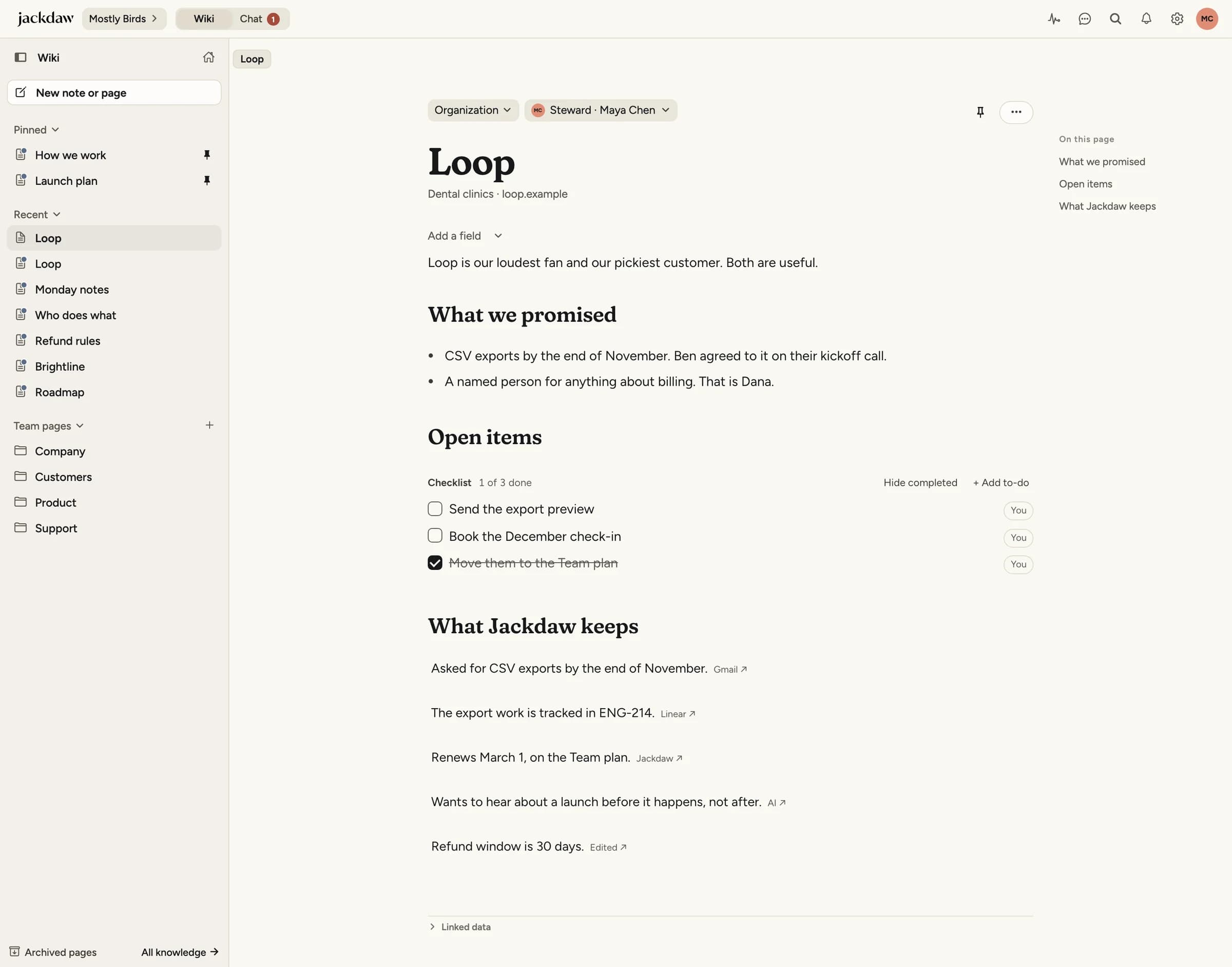
Jackdaw comes with the chat and the agents
Mem0 is the memory. You bring the agent, the model and wherever your team talks.
Jackdaw includes a chat and agents you hire, each with a job, a manager and a budget. What is said in the chat goes into the memory, and the agents read from it. One memory serves the whole team, and each person and each agent gets only what they are allowed to see.
If you already have agents you like and only need them to remember, this will matter less to you.
Mem0 can run on your own machines
Mem0's core is open source under the Apache-2.0 licence, with a server you can host yourself. Mem0 notes that some features of its hosted platform may not be available that way. Its custom plan adds single sign-on, audit logs and an on-premises option, and its site lists SOC 2 Type I, HIPAA and GDPR compliance.
Jackdaw runs as a hosted service only. It is not open source, and it has no single sign-on yet.
What each costs
| Mem0 | Jackdaw | |
|---|---|---|
| To start | Free | Free, with 200 credits to start |
| What free includes | For 30 days, 10,000 adds and 1,000 retrievals a month on Mem0's model. After that you connect your own model key, and the limits rise to 50,000 adds and 10,000 retrievals a month. | 200 credits |
| Paid | Use past the limits, up to a cap you set, or a custom plan with no published price | $10 per 1,000 credits, or $200 or $500 a month for more |
| Team seats | No price per seat | Everyone in the workspace, free |
Mem0's prices are from its pricing page and pricing documentation on November 25, 2026. Its Starter, Growth and Pro plans are no longer sold to new accounts. For a team that brings its own model key and stays inside the free limits, Mem0 costs less.
Which should you choose?
There isn't one answer. In general:
Mem0 is the better choice if you are a developer building an agent or an app, if your own users need memory, or if the memory has to be open source or run on your own machines.
Jackdaw is the better choice if a team wants its own work remembered across the AI tools it uses, if people need to read and correct what is remembered, or if you want the chat and the agents in the same place as the memory.