

claude-mem or Jackdaw: how to choose
Where they are the same, where they differ, what each costs, and which one fits how you work.
By Jackdaw Team
claude-mem and Jackdaw both give a coding agent a memory that outlasts the session. Each follows the work as it happens, keeps what matters, and hands the relevant part to the next session without being asked.
They differ in whose memory it is. claude-mem remembers one developer's sessions, on that developer's machine. Jackdaw is a team's memory: what comes out of everyone's sessions, the team's chat and its tools, kept as a wiki people can read.
We make Jackdaw, so weigh it with that in mind. The facts about claude-mem come from its repository, its pricing page and its TeamBrain documentation, read on November 25, 2026.
At a glance
| claude-mem | Jackdaw | |
|---|---|---|
| Best for | One developer who wants every session remembered | A team that wants its coding agents and its people on one memory |
| What it is | An open-source plugin that records your sessions and searches them | A wiki, a chat and agents, on one memory, with a plugin for coding tools |
| Where the memory lives | On your machine. Syncing it to the cloud is optional. | In your Jackdaw workspace |
| Shared with the team | Not yet. TeamBrain, its shared workspace, is in a pilot. | Yes, in a team workspace |
| What it keeps from a session | Short observations made from what the agent did | What was decided, the rules you gave, traps and fixes, and what shipped |
| Who reads it | Your agents, and you in a local viewer | Your agents, your teammates' agents, and the people on your team |
| Works with | Claude Code, Codex, Cursor, OpenCode and 11 more agents | Claude Code and Codex through its plugin. Cursor, Claude and ChatGPT through its connector. |
| Open source | Yes | No |
| Price | Free. Cloud sync is $12 a month. | Free for people. Agents and connected tools use credits. |
The first row is the main difference, and the rest follow from it.
claude-mem is better for one developer on one machine
claude-mem runs a second agent beside your coding agent. It turns what the agent does into short observations and gives later sessions a compact index of them, with search tools for going deeper. The memory is stored on your machine, in a local database. It is free, open source under the Apache-2.0 licence, and its repository has about 120,000 stars.
Jackdaw is a hosted service. Its plugin sends each prompt, and each finished turn, to your workspace. If you work alone, or nothing should leave your computer, claude-mem is the better choice.
Jackdaw is better when a team shares the memory
claude-mem's memory is per person. Team sharing, which it calls TeamBrain, is being developed with a small group of teams. Its site marks it as coming soon, and its price hasn't been announced.
In a Jackdaw team workspace, what a session produces is the team's memory. A teammate's agent starts with what yours decided yesterday, and each line shows who said it and which repository it came from. The same memory takes in what the team says in chat and what its connected tools hold, so an agent also knows what was decided outside a coding session.
They keep different things from a session
claude-mem's observer works from the agent's tool activity, so its observations record how the work was done. That record stays on your machine unless you turn on cloud sync.
Jackdaw keeps less. Its plugin sends your prompt and the agent's reply, never the tool calls or their output, and it removes passwords, keys and tokens on your computer first. From each turn it keeps what a teammate would need: what was decided and why, the rules you gave the agent, traps and their fixes, what was committed, merged or deployed, and what was left open.
Jackdaw's memory is a wiki people can fix
claude-mem has a local web viewer for your memory, sessions and settings, and every observation has an ID you can cite. Text you wrap in <private> tags is kept out of storage. Its README doesn't describe editing or deleting a single observation.
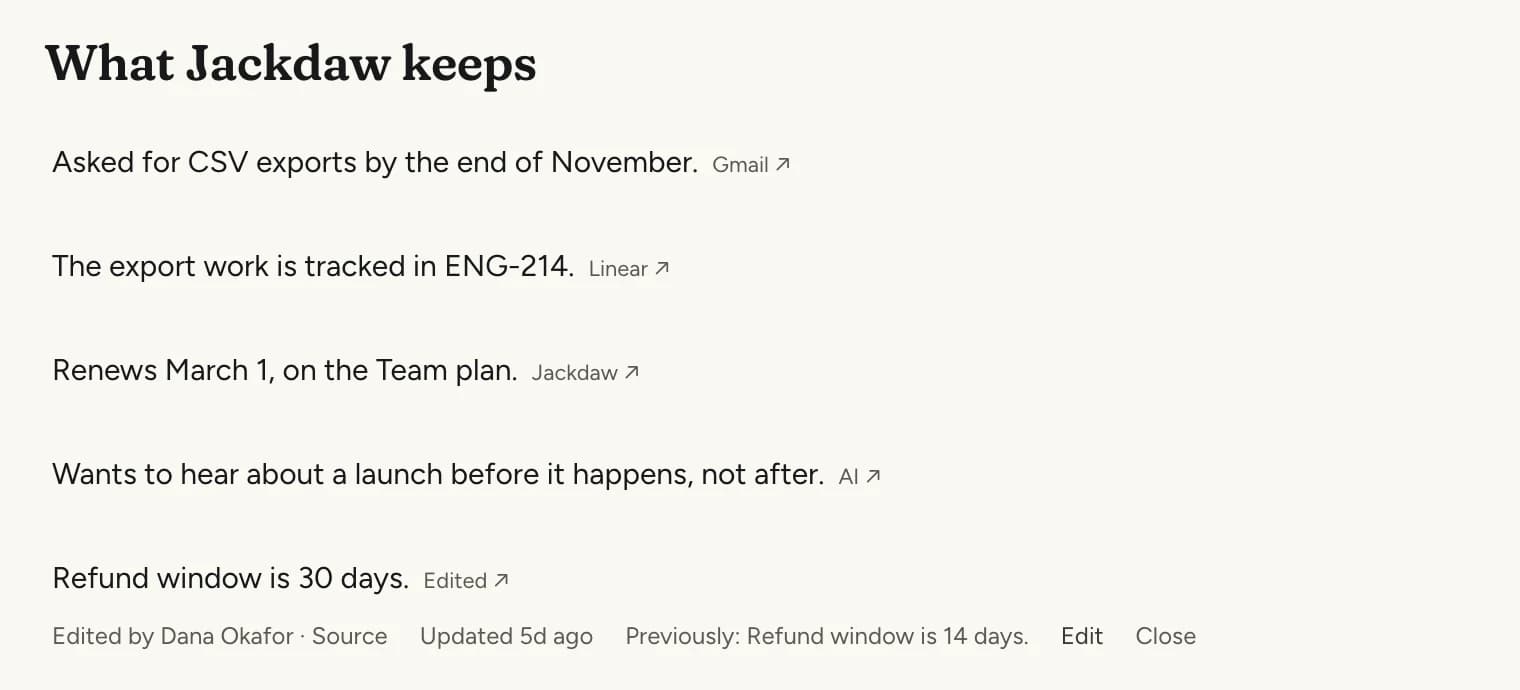
Jackdaw's memory is a wiki. Every line says where it came from. Anyone on the team who sees a wrong line can fix it, and the fix is the answer from then on for every person and every agent.
claude-mem works with more coding agents
claude-mem records sessions for Claude Code, Codex, Cursor, OpenCode and 11 more agents, and its search works from several others, including Claude's desktop app.
Jackdaw has a plugin for Claude Code and Codex. Cursor, Claude, ChatGPT and other tools connect to it over MCP, and ask for context when they need it.
What each costs
| claude-mem | Jackdaw | |
|---|---|---|
| To start | Free | Free, with 200 credits to start |
| Paid | Cloud sync for your own memory: $12 a month or $99 a year. Optional hosted plans for the observer's model use: $30 to $100 a month. | $10 per 1,000 credits, or $200 or $500 a month for more |
| Billed by | A flat price | Your AI tools reading Jackdaw and saving to it, and the work agents do |
| A team of five | TeamBrain's price isn't published | Everyone in the workspace is free. The team pays for credits. |
claude-mem's prices are from its pricing page on November 25, 2026. On one machine, claude-mem costs nothing, and Jackdaw can't match that.
Which should you choose?
There isn't one answer. In general:
claude-mem is the better choice if you are one developer, if your sessions should stay on your own machine, if you want open source, or if you use a coding agent Jackdaw has no plugin for.
Jackdaw is the better choice if a team wants its agents to share what each one learned, if people need to read and correct what is remembered, or if the memory should also hold what the team decides in chat and in its other tools.