

Claude Code's memory or Jackdaw: how to choose
What each one holds, where they overlap, and why a team may want both.
By Jackdaw Team
Claude Code's memory and Jackdaw both give a coding agent something to start from, so a new session doesn't begin from nothing.
They hold different things. Claude Code's memory holds instructions for working in a repository. Jackdaw holds what a team knows and has decided, across repositories, tools and people. They work well together, and we use both.
We make Jackdaw, so weigh it with that in mind. The facts about Claude Code come from its documentation, read on November 21, 2026.
At a glance
| Claude Code's memory | Jackdaw | |
|---|---|---|
| Best for | How to work in one repository | What a team knows and has decided |
| What it is | CLAUDE.md files you write, and notes Claude writes itself | A wiki, which Claude Code reads through a connector |
| Where it lives | In the repository and on your machine | In your Jackdaw workspace |
| Shared with the team | CLAUDE.md is, through source control. Claude's own notes stay on one machine. | Yes |
| Who else reads it | Claude Code | Claude, ChatGPT, Cursor, Codex, and the people on your team |
| When it is read | At the start of every session | When the agent asks |
| Where a line came from | The repository's history | Shown on every line |
| Price | Part of Claude Code | Free for people, and free for AI tools to read |
The first row is most of the answer, and the sections below fill it in.
Claude Code's memory is better for how to work in a repository
A CLAUDE.md file is a plain text file of instructions that Claude reads at the start of every session. The documentation suggests build commands, conventions, project layout and rules Claude should always follow. It can sit at four levels: your organization, you, the project, and you within one project. The project's file is shared with your team through source control, so it is reviewed and versioned like the code.
Claude Code also keeps what it calls auto memory: notes Claude writes itself from your corrections and preferences.
This is the right place for how to build, test and change the code. Jackdaw is not a replacement for it. Our own repository has a CLAUDE.md, and one of the things it tells Claude is when to ask Jackdaw.
Jackdaw is better for what the team decided, and why
A CLAUDE.md is meant to stay short. The documentation recommends under 200 lines, because a longer file takes up more of Claude's context and is followed less reliably. That suits rules. It suits history less well: why a design was chosen, what a customer was promised, what changed last month.
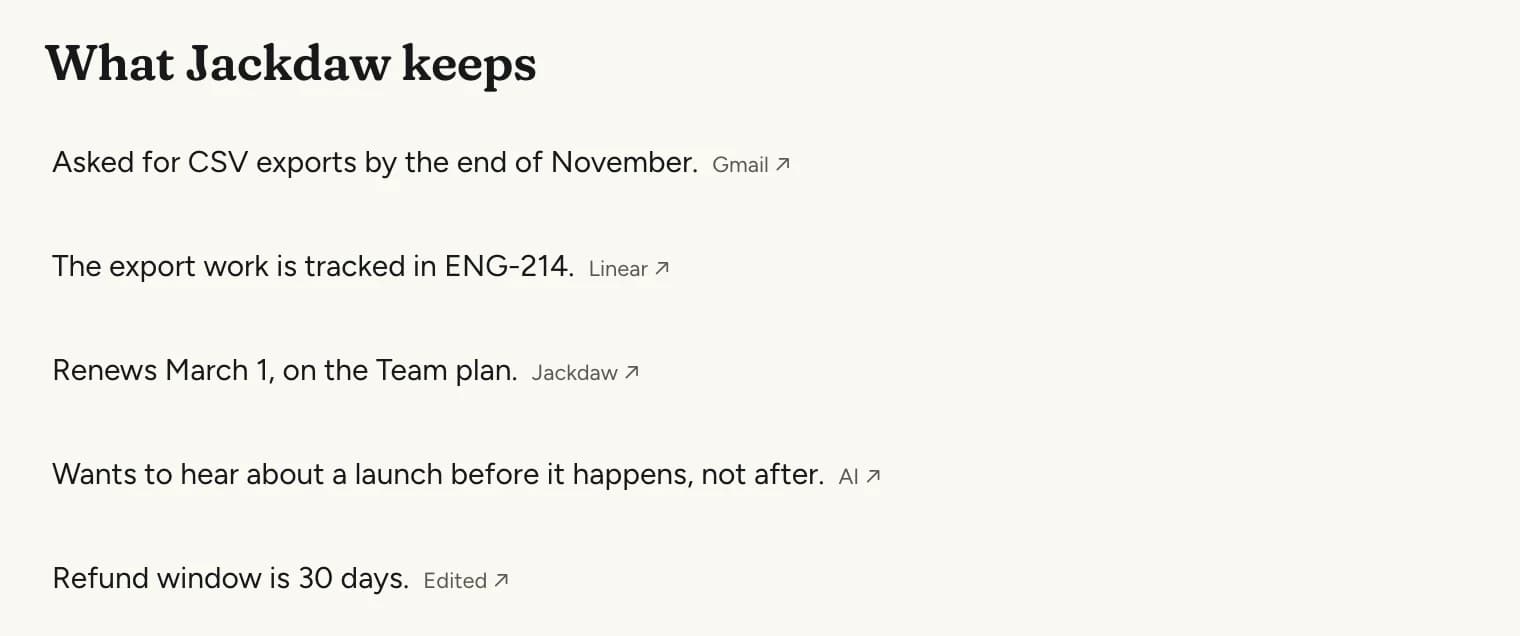
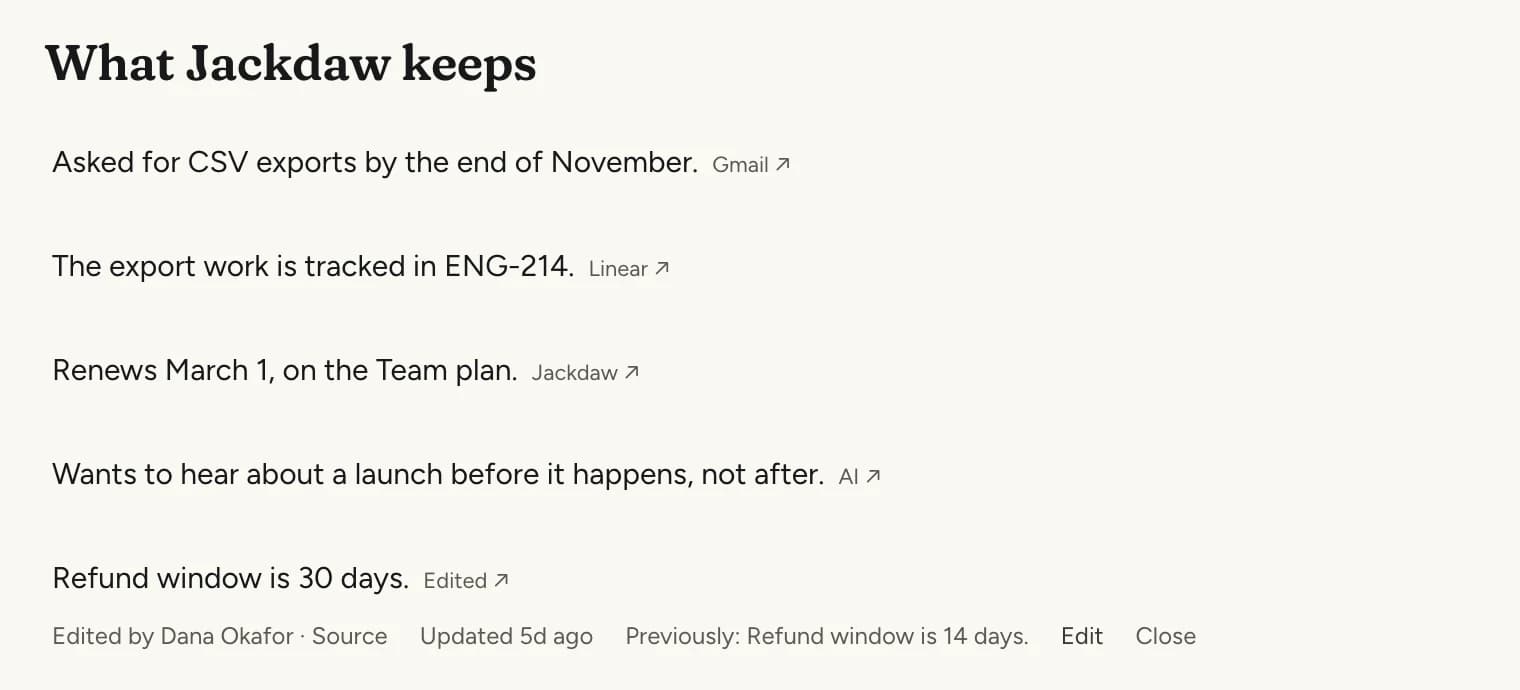
Jackdaw keeps that as a wiki. Every line says where it came from, and pressing it opens the original. When something changes, the old answer is kept, so an agent can be told why a decision moved as well as what it is now.
Claude's own notes stay on one machine
A project's CLAUDE.md reaches the whole team through source control. Auto memory does not. The documentation says it stays on the machine it was written on, and is not shared with other machines or cloud environments.
What an agent saves to Jackdaw goes to the team's wiki, marked as saved by an AI, where the next person's agent can read it. Each person, and each agent, gets only what they are allowed to see.
Jackdaw reaches other tools, and people who don't write code
Claude Code's memory is read by Claude Code. It can also read a repository's AGENTS.md files.
Jackdaw is read by Claude, ChatGPT, Cursor, Claude Code and Codex, and by people in the wiki and the chat. A correction somebody makes on a page is what every one of those tools gets from then on.
Claude Code reads its memory every session. Jackdaw is asked.
CLAUDE.md files load at the start of every session, along with the first 200 lines of auto memory's index. Claude always has them.
Jackdaw is asked. An agent sends a question and gets back what that question needs, not the whole workspace. That keeps it small, and it means the agent has to know to ask. A line in CLAUDE.md is the usual way to tell it.
What each costs
Claude Code's memory is part of Claude Code. In Jackdaw the wiki, the chat and your AI tools reading from it are free for everyone in the workspace. Credits pay for the work agents do and for Jackdaw reading the tools you connect. You start with 200 free, and 1,000 more cost $10.
Which should you choose?
Most teams won't have to. In general:
Claude Code's memory is enough if you work alone in one repository, or if what Claude needs is how to build, test and follow the conventions of the code.
Add Jackdaw if several people or several AI tools need the same answers, if decisions are made in chat and email as well as in code, or if you want to see where a line came from and correct it once for everyone.